

Canvas Print vs Framed Print: Which Looks Better in 2026?
Choosing between a canvas print vs framed print comes down to more than just personal taste. Each format has a distinct look, feel, and price point, and picking the wrong one can throw off an entire room. Whether you're decorating a minimalist apartment or filling a feature wall in your living room, the material and presentation of your art matters just as much as the image itself.
At Yourwallarts, we produce made-to-order wall art on premium canvas and acrylic glass, so we spend a lot of time thinking about how different formats affect the way art looks on a wall. That hands-on experience with print quality and materials gives us a practical perspective on this debate, one that goes beyond surface-level aesthetics. We've seen firsthand how the right format elevates a piece while the wrong one falls flat.
This article breaks down the real differences between canvas prints and framed prints, covering appearance, durability, cost, and which spaces each one suits best. By the end, you'll have a clear sense of which option fits your style, your budget, and the specific room you have in mind. No guesswork, just a straightforward comparison to help you decide with confidence.
Why the finish changes how art feels
The surface your print sits on directly shapes how you experience it. Art isn't just an image; it's a physical object that interacts with light, texture, and the wall around it. When you're weighing a canvas print vs framed print, you're really deciding how you want the artwork to live in your space and what feeling you want it to generate the moment someone walks into the room.
Texture and depth
Canvas has a woven surface texture that gives printed images a subtle, tactile quality. When light hits it at an angle, that texture becomes visible and adds a layer of depth that flat paper prints can't replicate. This is especially noticeable with landscapes, portraits, and bold graphic art, where the slight grain reinforces dimensionality and makes the image feel closer to a traditional painting than a reproduction.
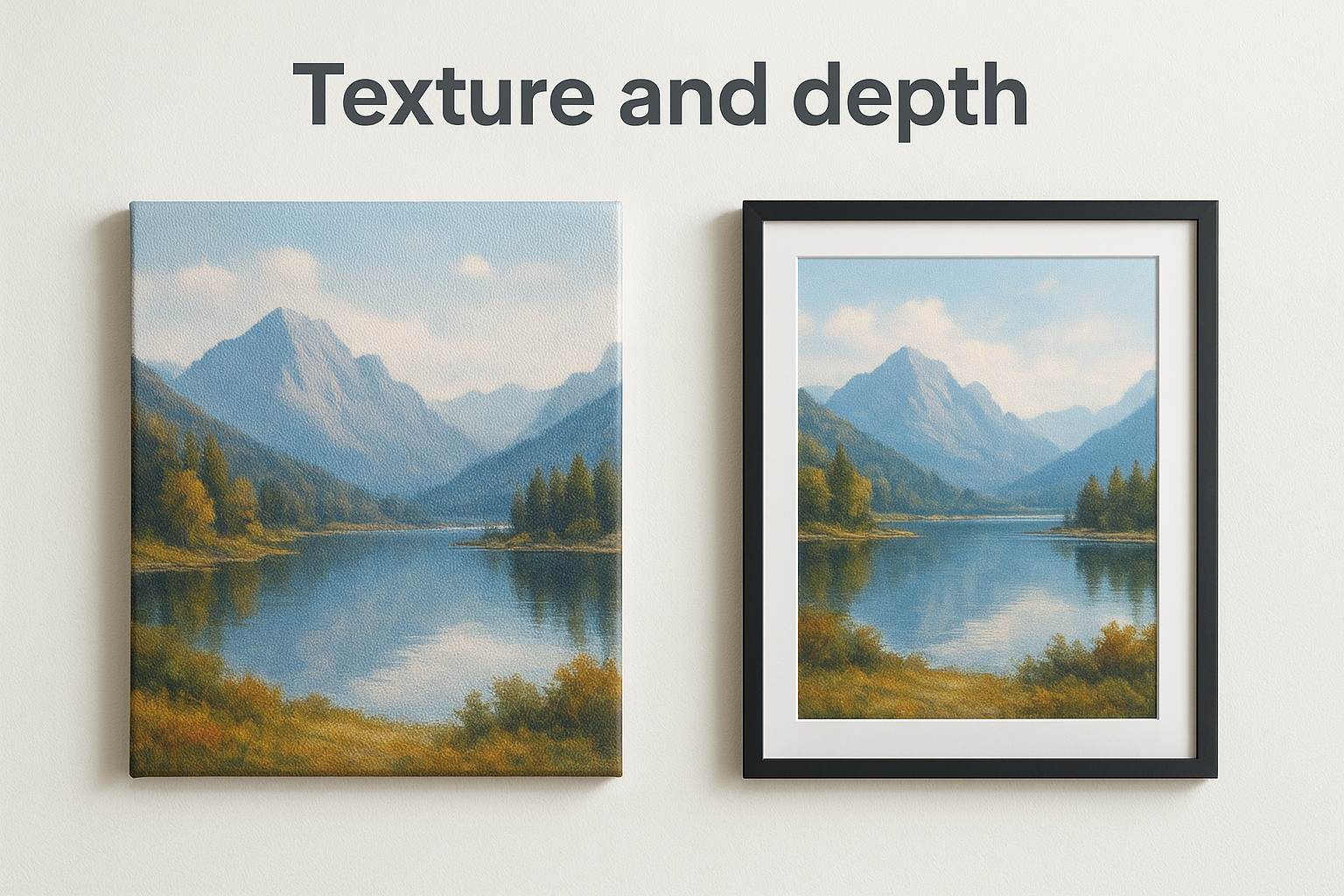
A canvas print tends to carry the weight of something gallery-worthy, while a framed print reads more like a finished photograph or graphic design piece.
Framed prints sit behind a layer of glass or acrylic that keeps the surface completely flat. The smoothness and high color fidelity this creates can work in your favor, particularly for detailed photography or artwork with fine linework. The image stays sharp, and colors often appear more vivid because there's no texture scattering the light across the surface.
How light behaves on each surface
Light is one of the most overlooked factors when choosing a format. Canvas absorbs some light, which reduces glare and keeps the image readable from almost any angle in the room. This makes it a strong choice for spaces that get heavy natural sunlight or where ceiling fixtures shine directly onto the wall.
Framed prints under glass are more sensitive to reflections, especially in brightly lit rooms. Some framed options come with anti-reflective glass, which helps considerably, but canvas sidesteps that issue entirely. If your wall sits opposite a window or under strong directional lighting, the matte quality of a canvas surface keeps the artwork visible and easy to look at throughout the day without repositioning or adjusting your lighting setup.
Canvas vs framed print differences that matter
When you strip away the aesthetic preferences, the canvas print vs framed print debate comes down to a few practical differences that affect everyday life with the artwork. These differences show up in how each format installs on your wall, how long it holds up, and how much maintenance it actually demands from you.
Mounting and installation
Canvas prints are typically stretched over a wooden frame called a stretcher bar, which makes them rigid and self-contained. Most come with a built-in hanging system, so you put a nail in the wall and you are done. Framed prints require more decisions upfront, including glass type, mat sizing, and hardware that can handle the frame's weight. Here are the main choices you face with a framed print:
- Glass type: standard, UV-protective, or anti-reflective
- Mat: adds visual breathing room but increases overall size
- Hanging hardware: varies by frame weight and wall material
The simpler the installation process, the less likely you are to spend an afternoon frustrated with a level and a pile of wall anchors.
Longevity and fading
Both formats can last decades when produced correctly, but the conditions in your space matter more than most people expect. Canvas holds up well in rooms with moderate humidity, while framed prints under UV-protective glass offer stronger resistance to light-induced fading over the long term.
Your biggest threat with either format is direct sunlight. A south-facing wall with no window coverings will degrade any print faster regardless of format, so placement matters as much as the material itself. Choosing archival-grade inks during production gives both options a meaningful lifespan advantage over budget alternatives.
How to choose the right option for your space
The single most useful starting point when choosing between a canvas print vs framed print is to look at the room itself before you look at the artwork. Your existing furniture, lighting conditions, and wall dimensions all point toward one format over the other, and reading those cues saves you from buying something that fights with the space instead of completing it.
Match the format to the room's mood
Modern and minimalist rooms tend to suit canvas prints well. The borderless, wrapped edge gives the wall a clean look without the visual weight of a frame, and the texture adds warmth to spaces that lean toward sparse, neutral palettes. If your room already has strong architectural detail, a frameless canvas keeps the art from competing with moldings, shelving, or geometric furniture lines.
Framed prints bring a sense of formality and deliberate curation to a space. If your room leans traditional or features wood tones, metal accents, or layered textiles, a well-chosen frame ties the artwork into the rest of the decor rather than leaving it floating on the wall.
Framed prints work best when a room already uses defined edges and structured details as part of its design language.
Consider the scale and wall space
Large, open walls respond well to oversized canvas prints, which carry visual weight without requiring additional elements like a mat or frame to look finished. Framed prints work naturally in gallery wall arrangements where you group multiple pieces at different sizes, because the frames create a visual rhythm that ties the grouping together.
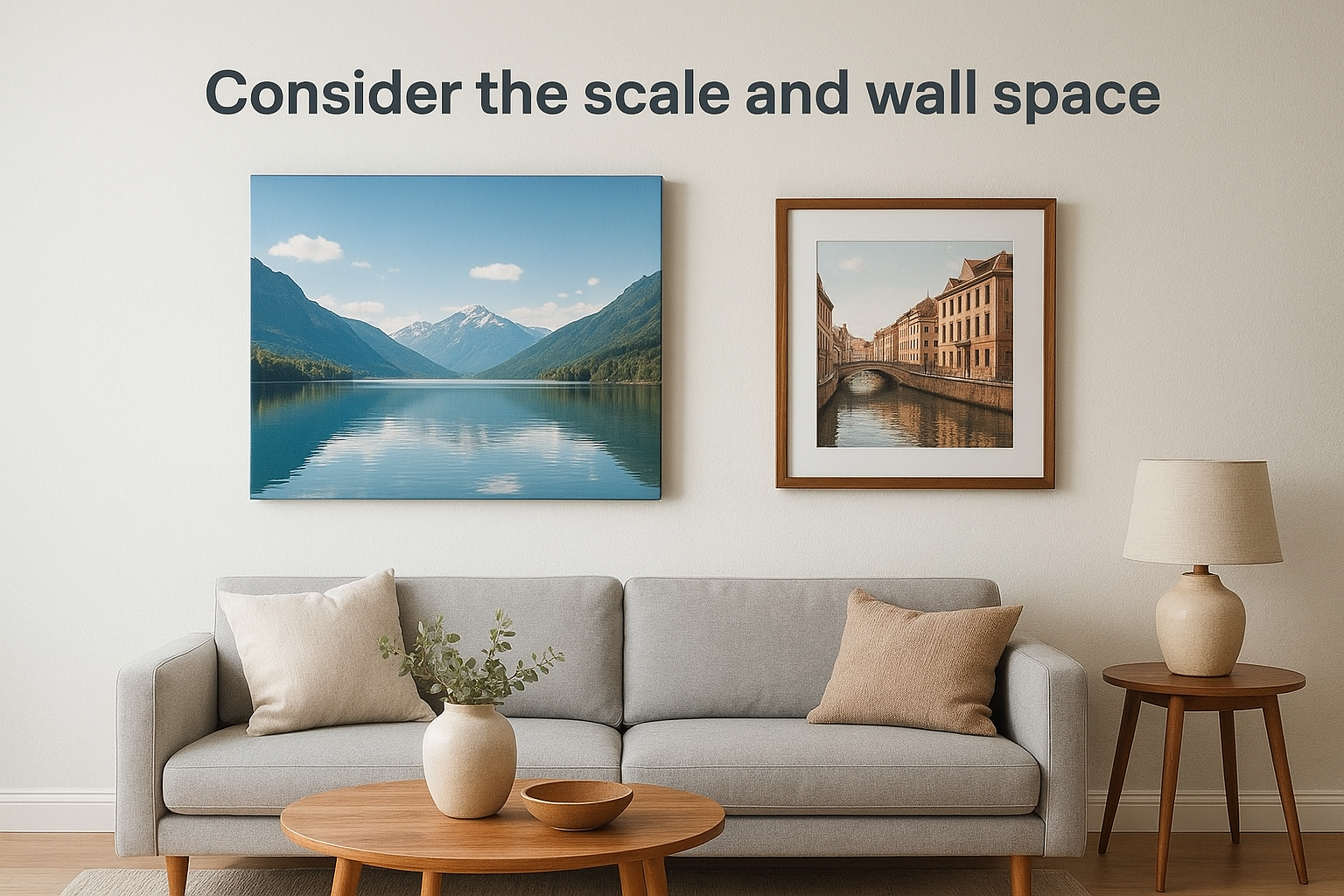
Use this quick guide to match format to situation:
- High natural light: canvas (less glare)
- Gallery wall layout: framed prints
- Single statement piece: canvas
- Photography or detailed linework: framed print
Cost, durability, and upkeep in 2026
Understanding the real cost of a canvas print vs framed print means looking beyond the sticker price. The format you choose affects what you spend now and what you spend later, and those two numbers don't always point in the same direction.
What you pay upfront
Canvas prints are generally more affordable at the point of purchase because they arrive ready to hang without additional framing costs. Framed prints often involve separate line items including the frame itself, mat board, and glass, which can push the total cost well above the base print price. If you're buying a framed print from a custom framing shop, labor adds to that further.
The gap between canvas and framed print costs widens significantly when you factor in custom framing rather than off-the-shelf options.
Here's a rough breakdown of where costs land for a mid-size print in 2026:
| Format | Print Cost | Framing/Extras | Typical Total |
|---|---|---|---|
| Canvas print | $40-$120 | Minimal | $40-$120 |
| Framed print | $20-$80 | $30-$150+ | $50-$230+ |
Long-term maintenance
Canvas requires very little upkeep. A soft, dry cloth removes dust without risk of damaging the surface, and you rarely need anything more than that. Framed prints with glass surfaces attract fingerprints and smudges more readily, especially in high-traffic rooms or homes with kids.
Replacing a damaged frame or cracked glass adds ongoing cost that canvas avoids entirely. If you want something that stays looking good with minimal effort, canvas holds a clear advantage over time.
Style and room-by-room recommendations
Matching art format to room function makes a bigger difference than most people expect. The same image printed on canvas versus framed under glass can feel completely different depending on the furniture, lighting, and purpose of the room it ends up in. Use the guidance below to narrow down your choice before you order.
Living rooms and open spaces
Living rooms typically benefit most from large-scale canvas prints because the borderless wrap holds attention across a wide wall without requiring a frame to look complete. If your living room has warm wood furniture or layered textiles, a framed print with a complementary frame finish can anchor the wall while tying into existing tones.
In open-plan spaces, canvas prints read better from a distance because the texture adds visual interest without relying on fine detail.
Your seating arrangement also matters here. If your sofa sits across from the art wall, a matte canvas surface handles the room's ambient light better than glass, which can reflect overhead fixtures and distract from the image.
Bedrooms and personal spaces
Bedrooms suit both formats well, but the deciding factor is usually the mood you want to set. Canvas prints with soft, moody imagery work naturally above a bed because they feel relaxed and approachable. For a bedroom that leans more curated, a framed print with a thin metal or wood frame adds a finished quality that fits styled, intentional interiors.
When weighing a canvas print vs framed print for a bedroom, consider whether you want the art to blend into the room or stand as a focal point. Canvas tends to blend; framed prints tend to stand out.
Your next step
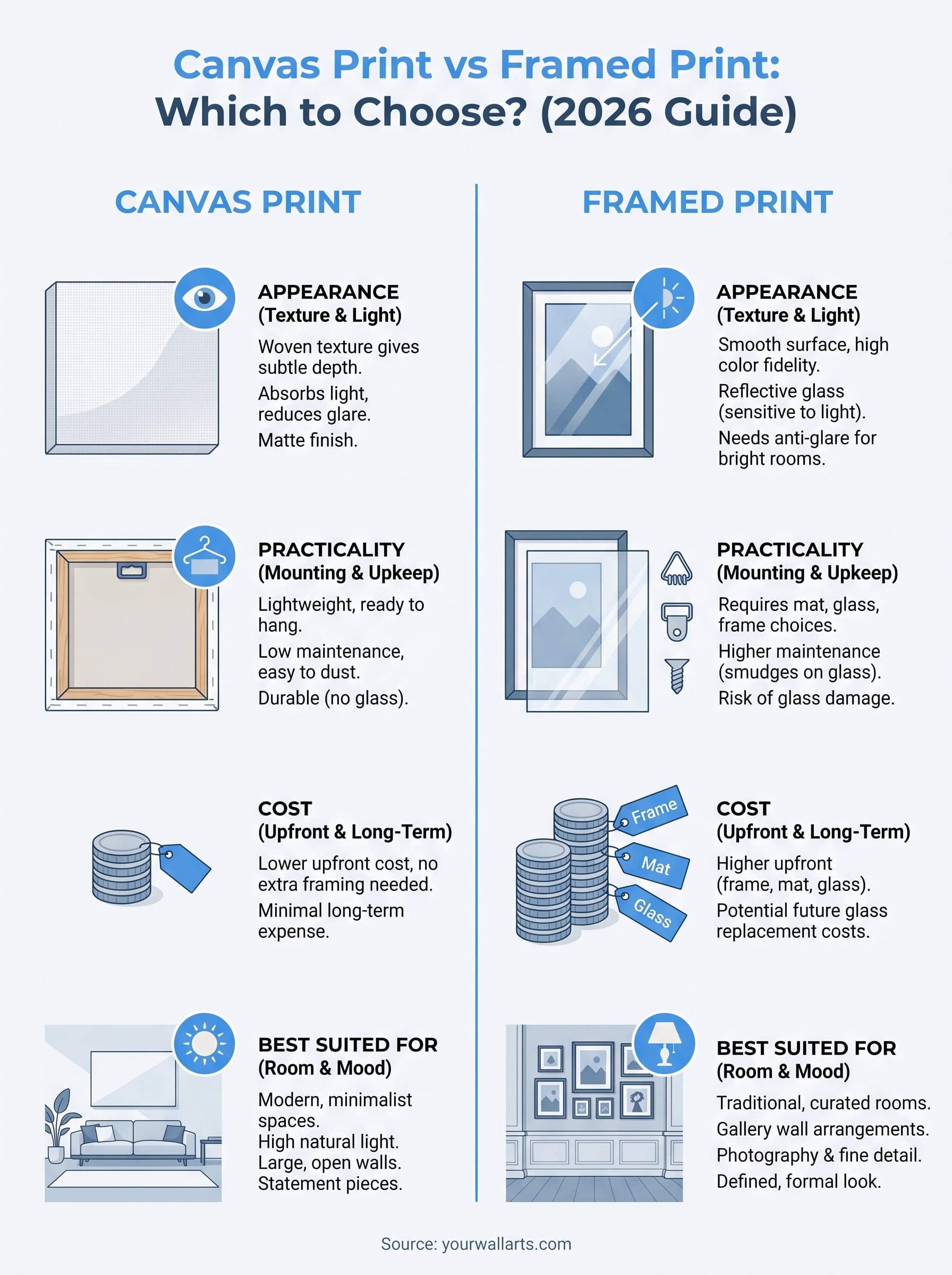
The canvas print vs framed print decision comes down to three core factors: your room's lighting, the mood you want to create, and how much upkeep you're willing to take on over time. Canvas gives you a texture-rich, low-maintenance option that works in most spaces and installs without fuss. Framed prints suit curated, formal rooms where structure and defined edges matter more than simplicity.
You now have everything you need to make a confident call. Pick the format that fits your space, order the right size for your wall, and commit to the decision. Both options look outstanding when you match them thoughtfully to the room. If you want premium-quality prints that arrive ready to hang, without separate framing costs or installation headaches, browse the full wall art collection at Yourwallarts. Every piece ships on canvas or acrylic glass, fully prepared for your wall, with free shipping included on every order.