

How High To Hang Wall Art: The 57–60 Inch Rule Made Easy
You just received your new canvas or acrylic glass print, and now you're standing in front of a blank wall with a hammer, a nail, and zero confidence. The question of how high to hang wall art hits differently when you're about to put a hole in the wall. Too high and the piece floats awkwardly near the ceiling. Too low and it looks like an afterthought.
Here's the good news: there's a straightforward rule that galleries and interior designers have used for decades. It's called the 57–60 inch rule, and it takes the guesswork out of positioning your art at a height that actually feels right. No math degree required, and it works whether you're hanging a single piece or a full gallery wall.
At Yourwallarts, we ship every canvas print with a built-in hanging system and every acrylic glass piece with a complete mounting kit, so the hardware side is covered. This guide handles the rest. Below, you'll find exact measurements, room-specific adjustments, and practical tips so your wall art ends up exactly where it belongs: at the perfect height, on the first try.
What the 57–60 inch rule actually means
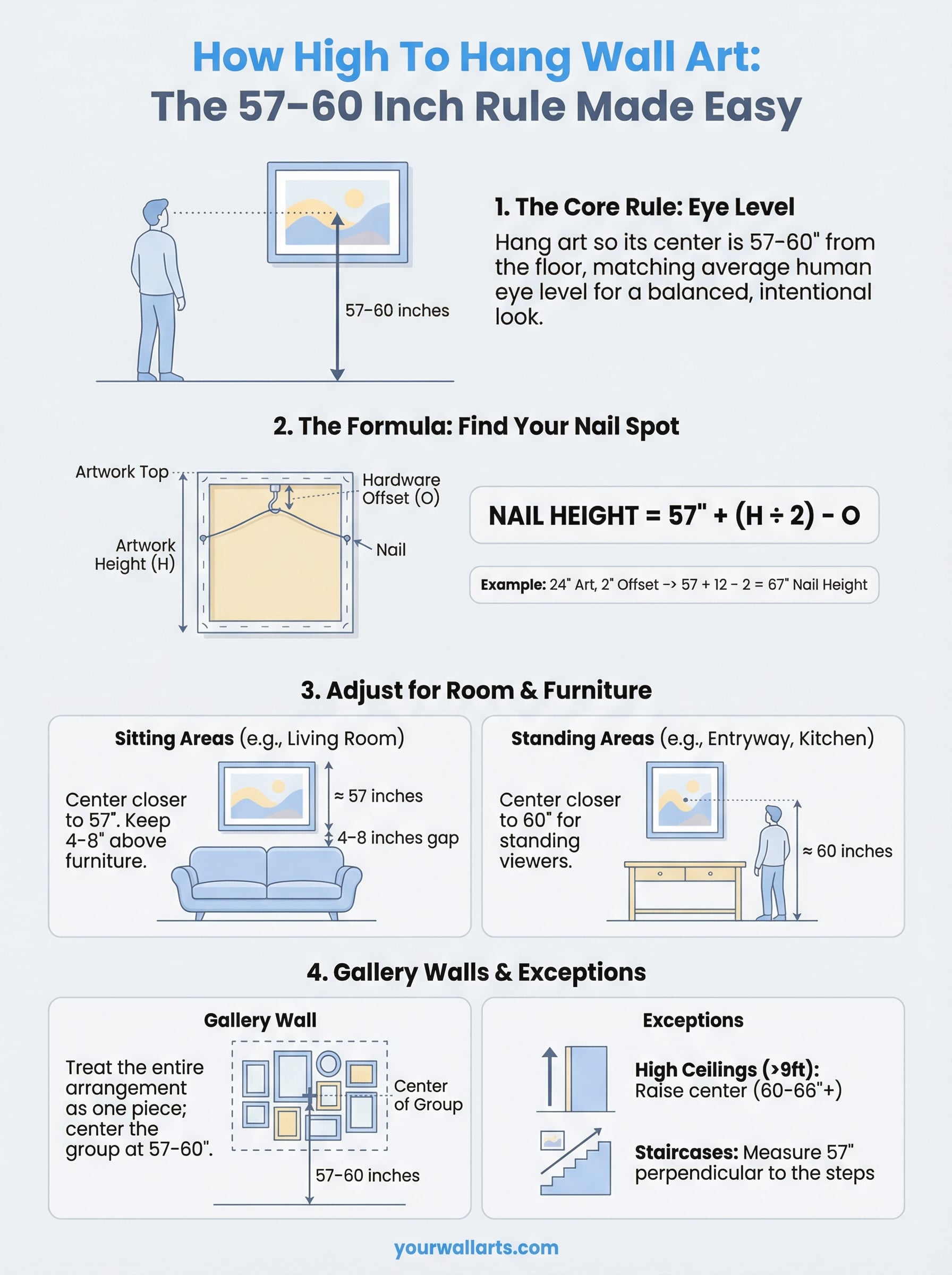
The 57-60 inch rule is simple: hang your art so that its center sits 57 to 60 inches from the floor. That range corresponds to average human eye level, which means when someone walks into a room, their gaze lands directly on the middle of the piece. Museums and professional galleries around the world use this same standard, and it's the reason art on those walls feels natural and intentional rather than random. Understanding this rule is the foundation for figuring out how high to hang wall art in any space you're working with.
Where the number comes from
The figure is not arbitrary. 57 inches from the floor is the standard eye level used by major gallery institutions as the baseline for displaying artwork, with 60 inches as the upper bound to account for taller viewers and larger rooms. Both numbers anchor the visual center of the art to the human eye, not to the wall itself or to the furniture below it. The result is that your eye meets the art directly instead of tilting up or glancing down, which is the fundamental difference between a display that feels balanced and one that feels off.
The center of your artwork, not the top or the bottom, should sit between 57 and 60 inches from the floor.
How the math actually works
This is where many people get tripped up. The rule refers to the center of the artwork, not the nail or hanging hook. To find where your nail goes, you need one short calculation. Here is the formula:
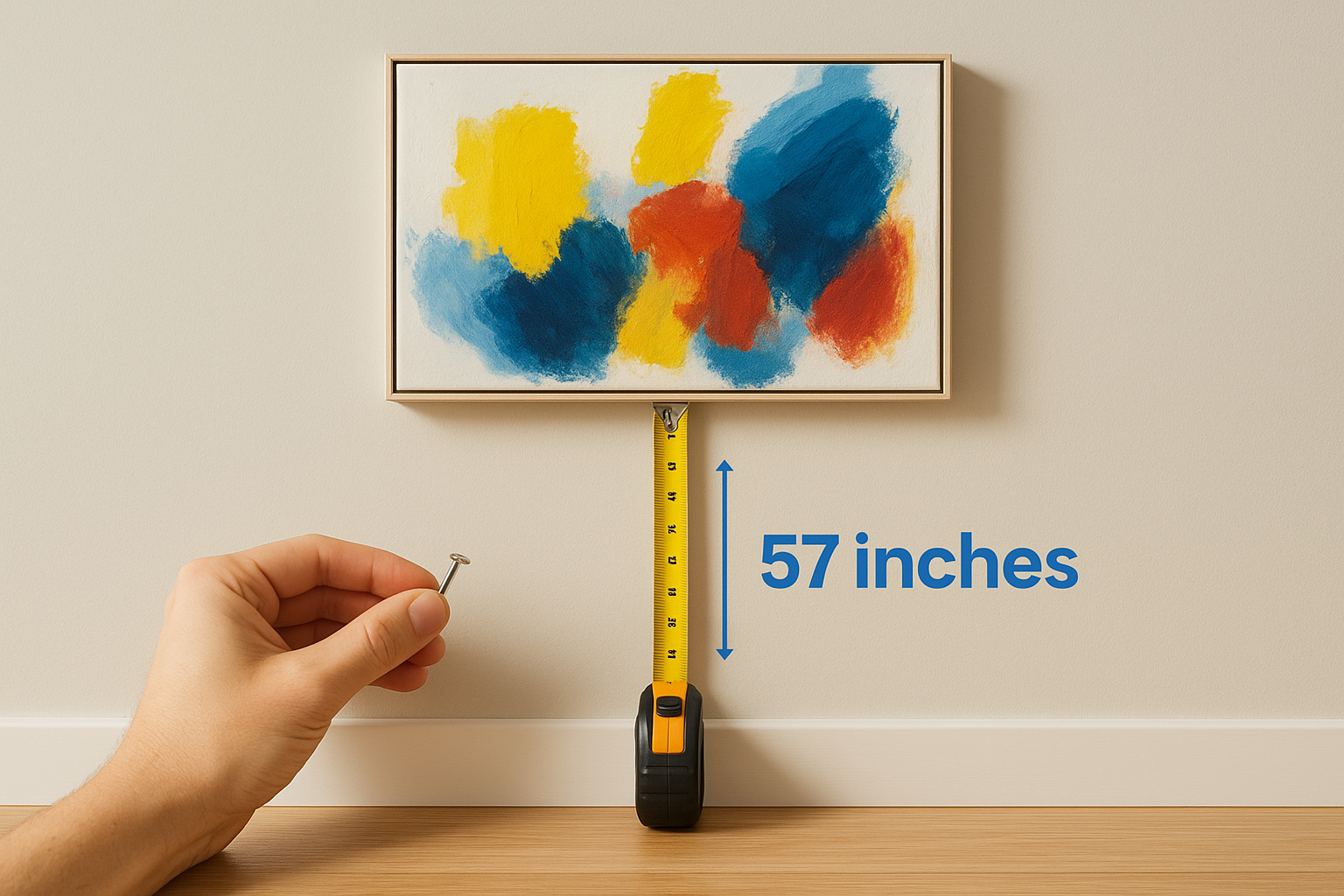
Nail height = 57 inches + (artwork height ÷ 2) - (distance from top of artwork to hanging hardware)
Here is a concrete example using a 24-inch-tall canvas where the hanging wire sits 2 inches below the top edge:
| Variable | Value |
|---|---|
| Target center height | 57 inches |
| Half of artwork height | 12 inches (24 ÷ 2) |
| Hardware offset from top edge | 2 inches |
| Nail placement from the floor | 67 inches |
You'd mark the wall at 67 inches, drive your nail there, and the center of the canvas lands right at 57 inches from the floor. Every Yourwallarts canvas ships with a built-in hanging system, so you can measure the hardware offset before you ever pick up a hammer. Acrylic glass pieces include a full hanging kit with clear instructions, making it easy to identify exactly where the mounting points fall relative to the top edge of the piece.
When to use 57 versus 60 inches
Stick with 57 inches as your default in most standard rooms with 8-foot ceilings and average-height furniture. Move closer to 60 inches in rooms with 9-foot or taller ceilings, in open-plan spaces where people are standing most of the time, or when you want a larger piece to feel more commanding on the wall. The difference of a few inches shifts the visual weight noticeably, so it is worth deciding before you mark the wall rather than after.
Step 1. Measure and mark your center point
Getting the center point right is where most people skip ahead too fast and end up filling nail holes later. Before you touch the wall, take two minutes to gather your tools and run the numbers. The math from the previous section becomes quick and painless once you have everything in front of you.
What you need before you start
Grab these four tools before you do anything else. Every item below is something you probably already own.
- Tape measure – for measuring both the artwork height and wall distance
- Pencil – a light mark erases easily, unlike pen
- Level – even a small bubble level keeps your piece from tilting
- Painter's tape – use a small strip to mark your spot before committing to a nail
How to find and mark the spot
Start by measuring the full height of your artwork in inches, then divide that number by two to get the center. Next, measure the distance from the top edge of the piece to the hanging hardware, whether that is a wire, a hook, or a bracket. With a Yourwallarts canvas, the built-in hanging system sits at a fixed point, so this measurement takes seconds.
Now apply the formula: 57 + (artwork height ÷ 2) - hardware offset = nail height. If your piece is 30 inches tall and the wire sits 3 inches from the top, your nail goes at 57 + 15 - 3 = 69 inches from the floor. Mark that point lightly with a pencil, then hold your level horizontally across the mark to confirm it is true before you drive anything into the wall.
Measure twice before you mark, and mark before you nail. One extra minute here saves you from patching holes later.
Knowing how high to hang wall art only pays off when your measurements are accurate, so treat this step as the foundation for everything that follows.
Step 2. Adjust for furniture and room use
The 57-inch baseline works well for open walls, but most rooms have furniture in the picture. When a sofa, bed, or dining table sits below your art, the relationship between the piece and the furniture matters as much as the distance from the floor. Knowing how high to hang wall art in these situations means adjusting your center point to account for what's already in the room.
Art above a sofa or console table
When hanging art above a sofa or console table, leave 4 to 8 inches of space between the top of the furniture and the bottom edge of the artwork. This gap keeps the piece visually connected to the furniture below without looking cramped. If your sofa back sits at 36 inches and your artwork is 24 inches tall, the bottom of the piece should land around 40 to 44 inches from the floor, which puts the center at roughly 52 to 56 inches, slightly lower than the standard 57 inches but far more balanced in context.
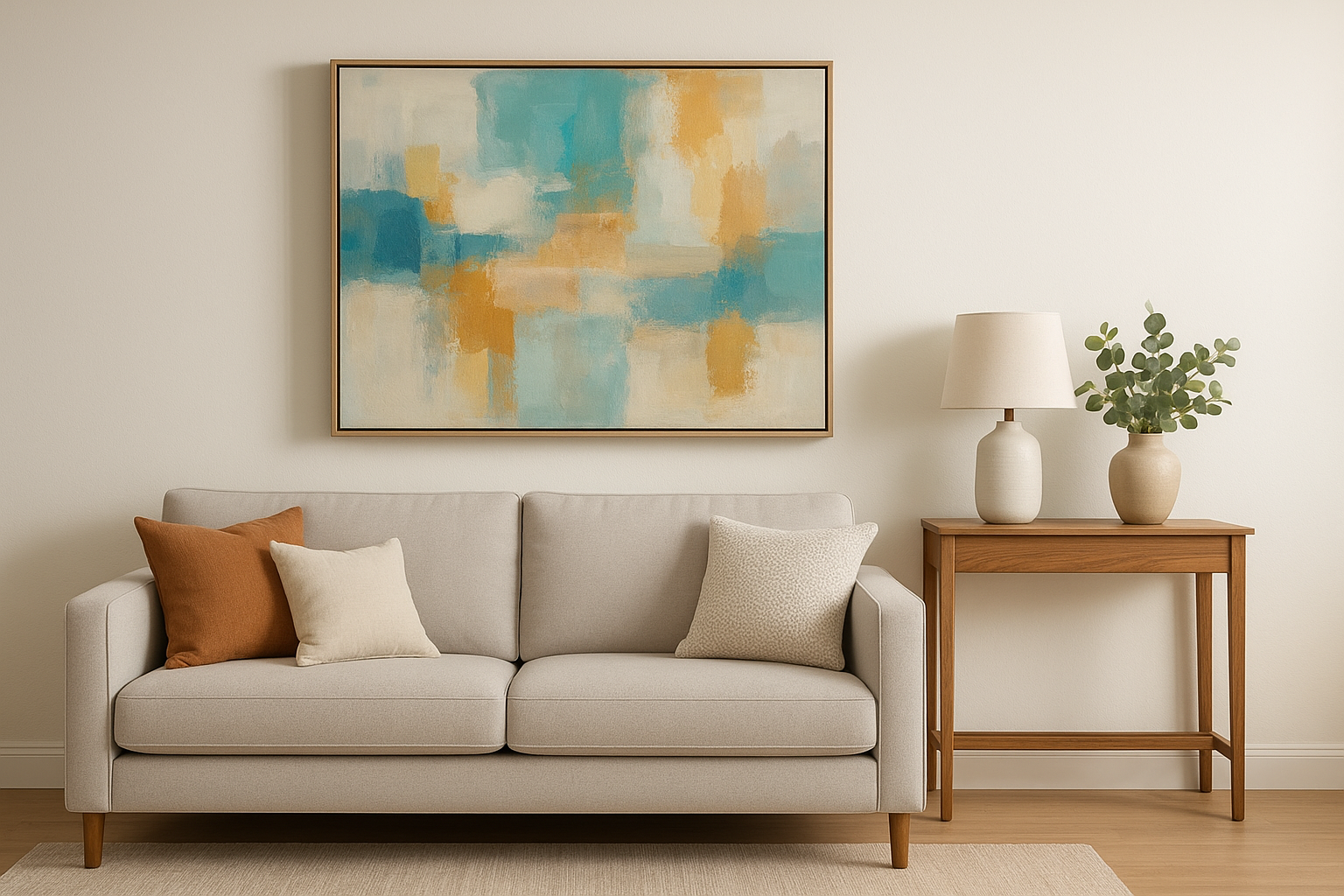
The art and the furniture should read as a single unit, not as two separate elements competing for attention on the same wall.
Art in rooms where people stand
Standing rooms like kitchens, entryways, and home offices shift the visual baseline upward. In these spaces, move your center point to 60 inches from the floor instead of 57, since visitors are on their feet and their eye level is correspondingly higher. A dining room where guests mostly sit can stay closer to 57 inches, while a kitchen where you prep meals standing up benefits from the full 60-inch placement.
Here is a quick reference for different room types:
| Room type | Typical activity | Recommended center height |
|---|---|---|
| Living room | Sitting | 57 inches |
| Entryway | Standing | 60 inches |
| Kitchen | Standing | 60 inches |
| Bedroom (above headboard) | Sitting/lying | 4-8 inches above headboard top |
| Dining room | Sitting | 57 inches |
Step 3. Plan and hang a gallery wall
A gallery wall adds more complexity than a single piece, but the same core principle applies: the visual center of the entire arrangement should sit at 57 to 60 inches from the floor, not the center of any individual frame. Start by treating the full grouping as one large artwork, and plan your layout before you drive a single nail into the wall.
Map your layout on the floor first
Lay all your pieces on the floor directly in front of the wall you're working on. Arrange them until you find a configuration that feels balanced, keeping the spacing between pieces consistent at 2 to 4 inches throughout. Once you're satisfied with the positions, measure the total height of the full arrangement from the top edge of the highest piece to the bottom edge of the lowest, then divide that number by two to find your collective center point. That center is what you align to 57 to 60 inches from the floor, not the center of any single frame in the grouping.
Spend time on the floor layout before you measure anything on the wall. Adjusting pieces on the floor costs nothing; adjusting them on the wall costs you spackle and time.
Transfer the layout to the wall
Cut pieces of painter's tape to match the dimensions of each frame and place them on the wall exactly as they appeared in your floor arrangement, with the collective center landing at your target height. This gives you a full-size preview of how high to hang wall art before any holes are made. Step back from the wall, check the spacing between each tape outline, and adjust as needed. Then use the formula from Step 1 to calculate the nail position for each individual piece based on its own height and hardware offset. Work outward from the center piece so the arrangement stays anchored throughout the process.
Exceptions: high ceilings, stairs, and big art
The 57-60 inch rule covers the vast majority of situations, but three specific scenarios break from that standard: rooms with high ceilings, staircase walls, and pieces that are simply too large to center at eye level. In these cases, knowing how high to hang wall art requires a different set of adjustments to keep your display looking intentional rather than awkward.
High ceilings
In rooms with ceilings above 9 feet, hanging art strictly at 57 inches can make the piece feel anchored to the floor rather than balanced within the space. Raise your center point to 60 or even 66 inches in these rooms so the art fills the vertical space more naturally. A reliable benchmark: the center of your art should sit roughly one-third of the way up the wall when ceilings exceed 10 feet.
In tall rooms, scale your placement proportionally to the ceiling height rather than sticking rigidly to 57 inches.
Staircase walls
Staircase walls present a moving eye-level problem because viewers see the art from multiple heights as they ascend or descend. The standard approach is to maintain the center of each piece at 57 inches measured perpendicular to the staircase angle, not straight down from the ceiling. When hanging a series of pieces along a staircase, keep a consistent diagonal line across the tops or centers of the frames so the eye moves naturally upward.
Oversized art
When a single piece spans more than 60 inches in height, centering it at 57 inches from the floor means the top edge climbs well past 87 inches, which looks fine in most rooms. Your priority shifts from hitting the exact center height to ensuring the bottom edge sits at least 8 to 12 inches above any furniture below it. Step back and assess the full wall before committing, since oversized art changes the visual balance of an entire room the moment it goes up.
You're ready to hang wall art
You now have everything you need to place art at the right height in any room, with any furniture, on any wall. The 57-60 inch rule gives you a reliable starting point, the step-by-step measurements give you precision, and the room-specific adjustments give you the flexibility to handle exceptions. Knowing how high to hang wall art is no longer a guessing game that ends in extra nail holes.
Put the guide into practice the next time you hang a piece and you'll notice the difference immediately. Art at the correct height feels like it belongs on the wall rather than something that just ended up there. Your room will look more considered, and your piece will get the attention it deserves.
Browse the full collection at Yourwallarts and find a canvas or acrylic glass print worth hanging at exactly the right height.
Find Wall Art Worth Hanging at Yourwallarts
Now you know exactly how high to hang wall art — the next step is finding the perfect piece. Explore our collections of premium canvas and acrylic glass prints, all made to order with free shipping worldwide.
- Abstract Canvas Prints — Make a bold statement with expressive abstract art for any wall.
- Nature & Landscape Wall Art — Bring the outdoors in with serene landscape prints for living rooms and bedrooms.
- Botanical & Floral Canvas Prints — Beautiful flower art that works perfectly above sofas, beds and consoles.
- Black & White Wall Art — Timeless monochrome prints ideal for minimal and contemporary spaces.
- Seascape Canvas Prints — Calming ocean scenes that look stunning as a single large-format centrepiece.
All Yourwallarts prints are made to order on premium canvas and acrylic glass. Free shipping and 30-day returns on every order.