

What Is a Canvas Print? Materials, Process, and Differences
If you've ever shopped for wall art online, you've probably come across the term and wondered: what is a canvas print, exactly? It's one of the most popular ways to display artwork, photography, and graphic designs at home, but the term gets thrown around loosely, and it's easy to confuse canvas prints with traditional paintings or standard framed posters. They're not the same thing, and the differences matter more than you might think.
A canvas print is a reproduction of an image, digitally printed onto canvas fabric and typically stretched over a wooden frame. The result is a piece that looks and feels closer to a painting than a paper print, with texture you can actually see and touch. At Yourwallarts, canvas is one of our two premium finish options (alongside acrylic glass), and we produce every piece made-to-order, so we know the process inside and out. That hands-on experience is exactly what shaped this guide.
Below, we'll break down the materials involved, walk through how canvas prints are manufactured step by step, and explain how they stack up against other common wall art formats. Whether you're buying your first piece or choosing between finishes, this article gives you the full picture, so you can make a decision based on facts, not guesswork.
Why canvas prints work for wall decor
Canvas prints have become one of the most popular choices for home decorators because they solve a problem that standard posters and framed paper prints never fully addressed: they look like they belong on the wall rather than just hanging on it. When you understand what is a canvas print and how it interacts with light and space, it becomes clear why so many people choose canvas over other formats. The combination of texture, depth, and a frameless profile makes canvas prints feel deliberate, not like afterthoughts.
Texture changes how art reads in a room
A flat paper print reflects light uniformly across its surface. Canvas doesn't. The woven fabric creates subtle variations in how light catches the image, which gives the piece a visual energy that flat prints lack. When you stand across the room from a canvas print, it reads more like a painting than a reproduction. This happens because the ink sits slightly within the textile grain, creating a micro-texture that your eye picks up even when you're not consciously looking for it.
The texture of canvas fabric is what makes a printed image feel like it was made to be displayed, not just copied.
Even high-resolution photographs printed on canvas gain a quality that looks deliberately artistic. The grain doesn't blur the image; it adds dimension to it. For room settings like living rooms, bedrooms, or office walls where you want the art to anchor the space visually, that textural quality is hard to replicate with other materials.
Canvas adapts to almost any room style
One practical strength of canvas prints is their visual flexibility across interior styles. Whether your space leans toward minimalist, industrial, rustic, or modern, canvas rarely fights with the room. Paper prints in frames draw the eye to the frame itself, which can clash with your existing furniture or wall color. Canvas wraps around the stretcher bars and presents the image without a border competing for attention.
Hanging a large canvas piece works with dark walls or light walls because the matte surface avoids glare. You won't need to position it away from windows or lamps just to make it readable. That adaptability makes canvas the practical pick when you want art that works with your space rather than requiring the space to work around it.
Canvas prints hold up over time
Most paper prints, even when framed under glass, are vulnerable to moisture, fading, and yellowing over the years. Canvas, especially when treated with a UV-protective coating, resists fading significantly longer than standard paper stock. The polyester-cotton blend used in quality canvas prints also handles minor humidity changes well, so the material won't warp or bubble the way paper can.
The result is a piece that maintains its appearance for years without demanding special care beyond occasional light dusting. For something you're committing to a wall long-term, that durability is worth factoring into your decision before you buy.
What canvas prints are made of
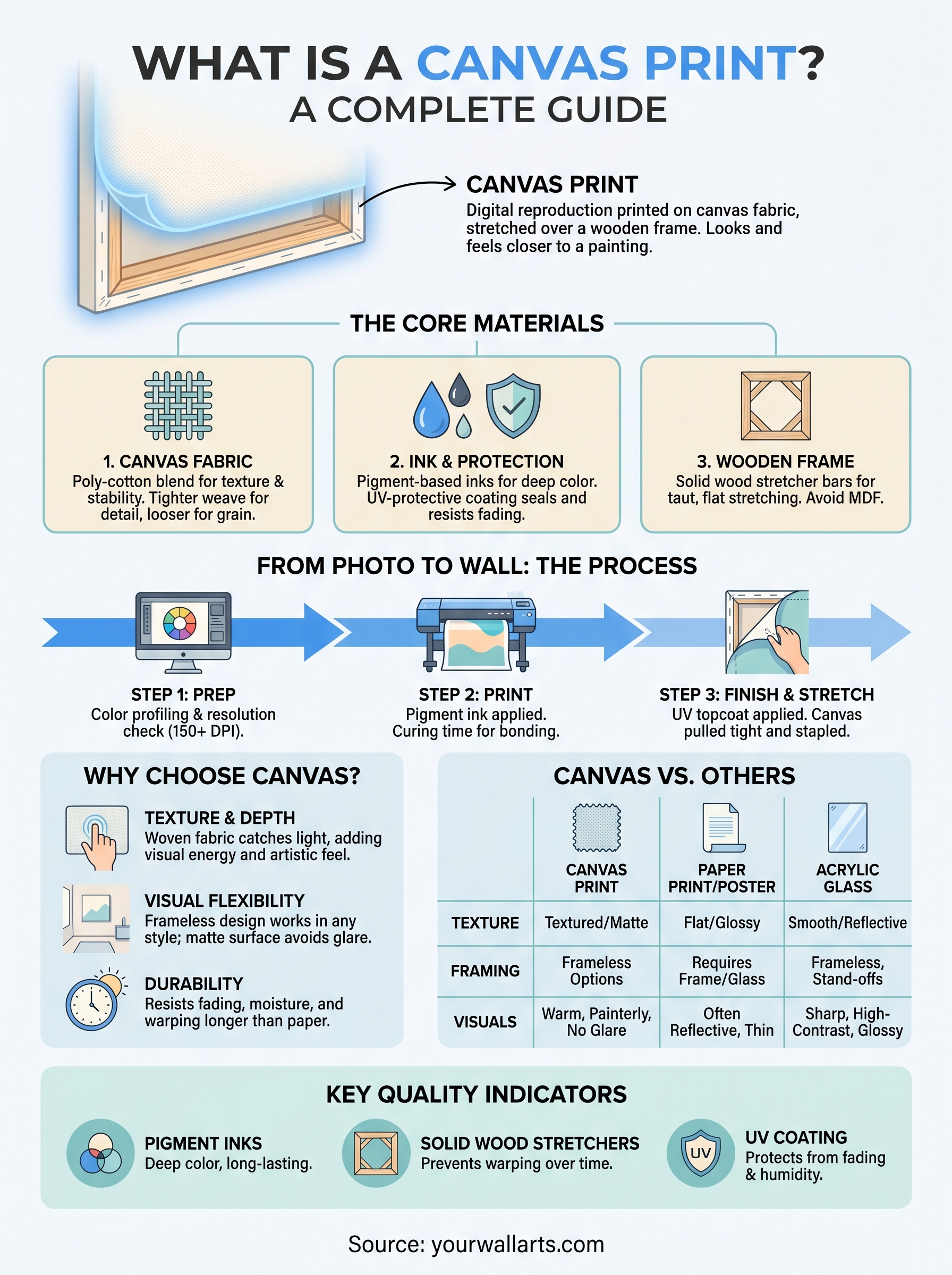
Understanding what a canvas print is starts with knowing what goes into it. A canvas print combines three core materials: the fabric itself, the ink used to apply the image, and the wooden frame underneath. Each component affects the final look and durability, so it's worth knowing what separates a quality piece from a cheap one before you buy.
The canvas fabric
The fabric in a canvas print is almost always a polyester-cotton blend, though some manufacturers use 100% cotton or 100% polyester. The blend is the most common choice because it balances the best qualities of both fibers. Cotton contributes a natural texture and softness that helps the print look organic and dimensional, while polyester adds stability and resistance to stretching or warping over time.
The weave pattern also matters. A tighter weave produces a smoother surface that holds fine detail well, making it a better fit for photographs with intricate textures or sharp lines. A more open weave adds visible grain to the image, which works well for painterly or abstract artwork but can soften the sharpness of a high-resolution photo.
The fabric weave is one of the most overlooked factors when judging canvas print quality, but it directly affects how crisp or painterly your finished piece looks.
Ink and protective coating
Modern canvas prints use pigment-based or dye-based inks applied through large-format inkjet printers. Pigment-based inks are generally preferred for wall art because they bond more deeply with the fabric fibers and resist UV fading significantly better than dye-based alternatives. After printing, most quality canvas prints receive a UV-protective coating that seals the surface and extends color longevity.
That protective layer also gives the print a slight sheen and makes the surface easier to clean with a dry or lightly damp cloth. Without it, the ink sits exposed to humidity and light, which shortens the lifespan of the piece noticeably. When you're choosing a canvas print, confirming whether a protective coating is included is one of the simplest ways to gauge overall quality.
How canvas prints are made from photo to wall
Knowing what is a canvas print involves more than understanding the materials; the production process itself shapes the final result. Each stage, from the digital file to the finished stretched piece, affects color accuracy, sharpness, and overall durability. A shortcut at any step shows up in the finished product, which is why the process matters as much as the materials.
File preparation and color calibration
Before any ink touches fabric, the image file goes through color profiling and resolution checks. Professional canvas printing uses ICC color profiles to translate the colors on your screen into values the printer can reproduce accurately on fabric. Without this step, the colors you see on a monitor will not match what comes out of the printer. Most quality print setups also require a minimum resolution of 150 DPI at the final print size to avoid visible pixelation across the finished canvas.
Skipping color calibration is the most common reason a canvas print looks washed out or oversaturated compared to the original image.
Printing, stretching, and finishing
Once the file is prepared, a large-format inkjet printer applies pigment-based inks directly onto the canvas fabric. The print runs at high resolution, and the ink is given time to cure and bond with the fibers before any handling. After printing, a UV-protective topcoat is applied to seal the surface and protect the colors from fading under normal lighting conditions.
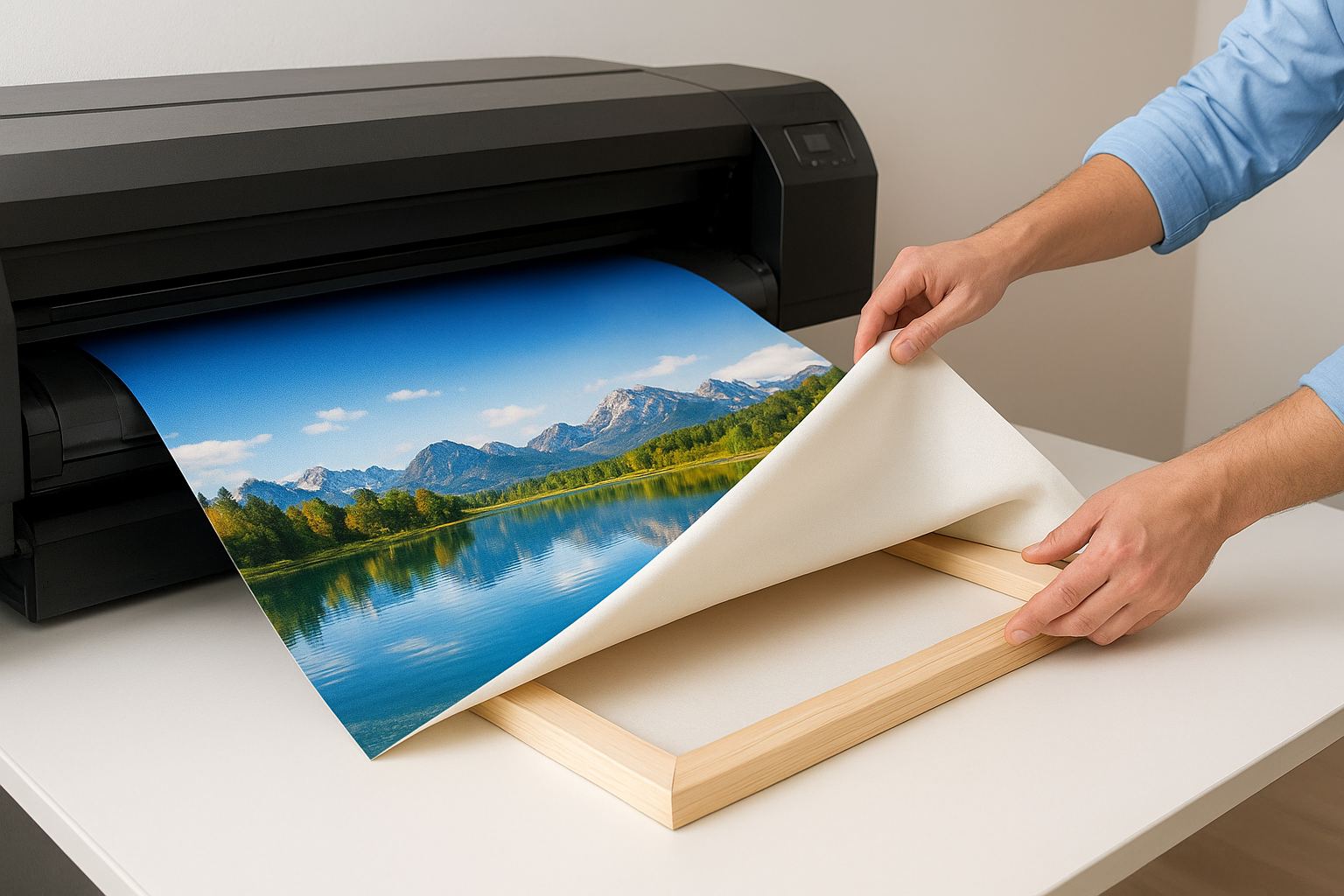
The final stage is stretching. The printed canvas is pulled tightly over a wooden stretcher frame and stapled along the back, so the image wraps cleanly around the sides and the front surface stays taut and flat. A loose canvas will wrinkle and sag over time, so proper tension at this stage determines how the piece looks years down the line. When you receive a quality canvas print, the corners should be clean and flat, with no visible puckering or slack across the surface.
Canvas prints vs paper prints, posters, and acrylic
Before you commit to a format, it's worth understanding exactly how canvas stacks up against the alternatives. Knowing what is a canvas print is useful, but knowing how it compares to paper prints, posters, and acrylic glass is what helps you pick the right material for your space and budget.
Canvas vs paper prints and posters
Paper prints and posters are the most affordable wall art format, but that lower cost comes with real trade-offs. Standard paper stock is flat, glossy or matte depending on the finish, and has no texture. When you hang a paper print without a frame, the edges curl and the surface can wrinkle from humidity. Even framed under glass, a paper print still looks like a reproduction rather than a piece of art, because the glass creates distance between the image and the viewer.
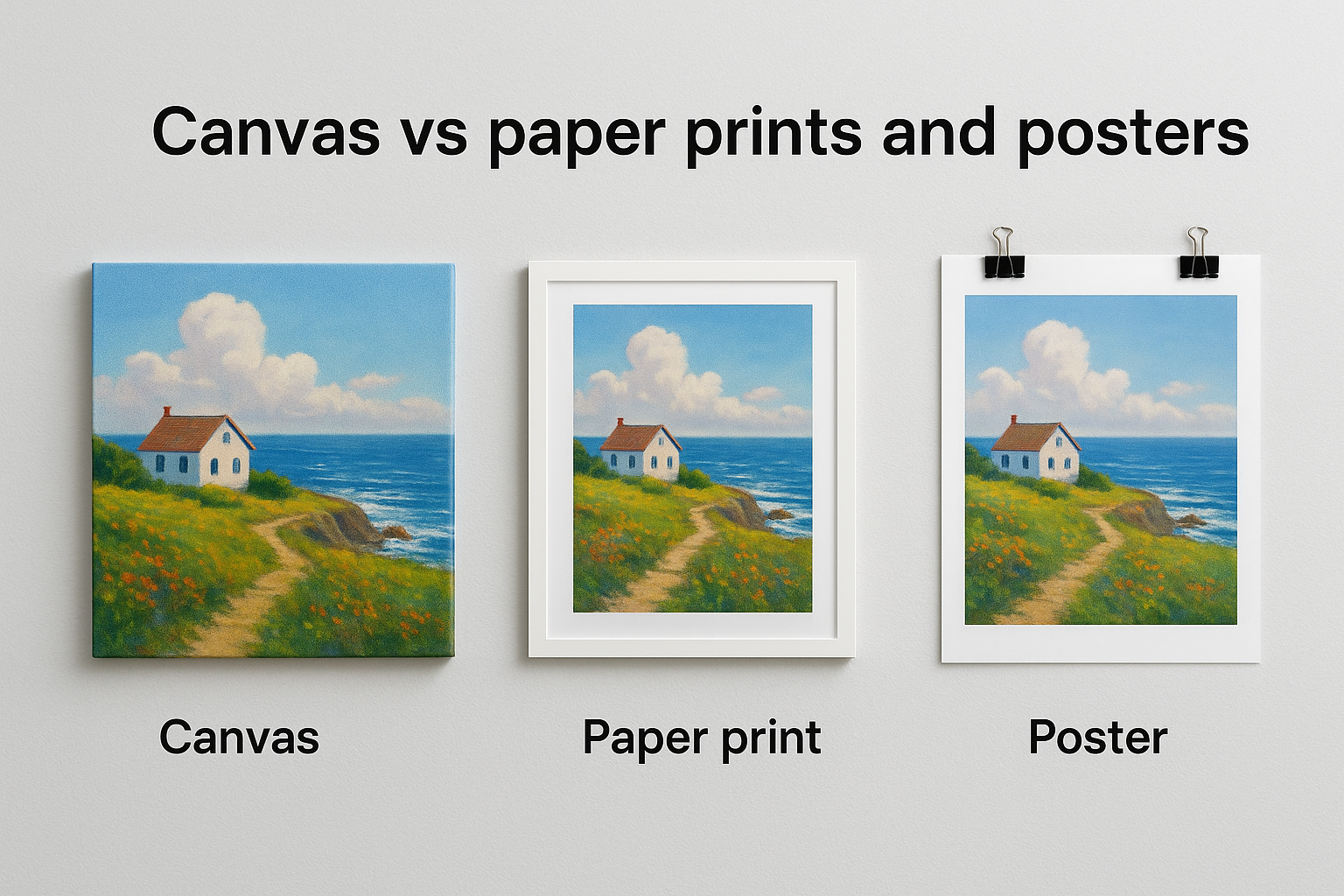
Canvas closes that distance. The image sits on a textured fabric surface that catches light the way a painting does, and the frameless profile means nothing stands between the image and the room. For large-format pieces especially, canvas maintains visual impact at a size where paper would feel thin and impersonal.
Canvas gives you the look of a painting at a fraction of the cost of original artwork, which is something a paper print simply cannot match.
Canvas vs acrylic glass
Acrylic glass sits at the opposite end of the visual spectrum from canvas. Where canvas is warm, textured, and matte, acrylic is sharp, smooth, and high-gloss. Images printed behind acrylic appear incredibly vivid because the material amplifies color depth and contrast in a way that fabric cannot. That makes acrylic the better choice for bold graphic art, high-contrast photography, or modern interiors that lean toward sleek and minimal.
Canvas, by comparison, suits a wider range of styles. The matte surface works without glare in any lighting condition, while acrylic needs careful placement to avoid reflections. Both are premium formats, so the choice comes down to whether you want warmth and texture or sharp, gallery-level vibrancy.
How to choose size, wrap, and quality
Once you know what is a canvas print and how it compares to other formats, the next step is choosing the right one for your specific wall. Three decisions matter most before you buy: the size relative to your wall space, the wrap style around the frame edges, and the quality indicators that separate a lasting piece from one that fades or sags within a year. Getting all three right means you won't need to redo the decision six months later.
Picking the right size for your wall
The most common mistake people make with canvas prints is buying too small. A piece that looks substantial on a product page can disappear on a full wall, especially in rooms with high ceilings or wide open spaces. A reliable guideline is to aim for art that fills 60 to 75 percent of the available wall width above a piece of furniture, like a sofa or bed. For a blank wall with no anchor furniture, going larger reads as intentional rather than sparse.
Measure your wall before you order, not after, so you're choosing a size based on your actual space rather than guessing.
Wrap style and what it means for the image
When canvas wraps around the wooden frame, the edges can be handled two ways. A gallery wrap continues the printed image around all four sides, so the piece looks complete from any angle without needing a frame. A mirror wrap reflects the outer edge of the image onto the sides, which works well when you don't want the composition interrupted. If you're displaying a photograph where the subject is centered, gallery wrap is usually the cleaner choice.
What to look for in quality
Pigment-based inks and a UV-protective coating are the two most important quality markers to confirm before ordering. Beyond that, check that the stretcher bars are solid wood rather than MDF or composite materials, which can warp under changing humidity. Tight, even tension across the canvas surface with clean, flat corners tells you the piece was stretched properly and will hold its shape over time.
Putting it all together
Now you know what is a canvas print from every angle: the materials behind it, the process that produces it, and how it compares to paper prints, posters, and acrylic glass. Canvas works because it combines texture, durability, and visual warmth in a way that no other format matches at the same price point. The fabric surface catches light like a painting, the UV-protective coating keeps colors strong for years, and the frameless profile fits almost any room style without friction.
Your next step is picking the right piece for your wall. Size, wrap style, and ink quality are the three variables that determine whether your canvas print looks intentional and polished or like an afterthought. Get those right, and the piece will hold its place on your wall for a long time. If you're ready to browse options built on these same standards, explore the full collection at Yourwallarts.